Regulatory requests do not arrive with notice, and they rarely ask for something the brokerage does not have. They ask for something the brokerage cannot assemble quickly. The difference between a routine information request and a genuinely damaging one is almost entirely a function of how the firm's data was structured months earlier — long before anyone knew a question was coming.
What being audit-ready actually means
Audit readiness is often confused with document retention. Keeping records is the minimum; being able to answer a specific question about a specific client on a specific date, within hours, is the actual requirement. A regulator asking who approved an account, what the client's declared experience was at the time, which risk tier was applied and what happened to their first three trades is asking one question — but for most brokerages it is four systems and a week of work.
The operational cost of that gap is not the request itself. It is what the request displaces: senior operations time, compliance attention and engineering hours, all pulled away from the business for as long as the assembly takes.
The trail a brokerage has to be able to produce
- Client identity: documents, verification results, provider, timestamp, reviewer
- Suitability: declared experience, risk tier applied, leverage granted and by whom
- Every change to a client record, with actor, previous value and time
- Trade and exposure history reconcilable against the trading server, not a copy of it
- Communications: which notice went out, through which channel, and whether it delivered
Each of these belongs to a different part of the stack, which is exactly why the trail has to be designed rather than assumed. Records that exist in five places with five different notions of "when" cannot be assembled into a single narrative under time pressure.
An auditor is not testing whether you kept the data. They are testing whether you can explain it.
Make the record a by-product, not a project
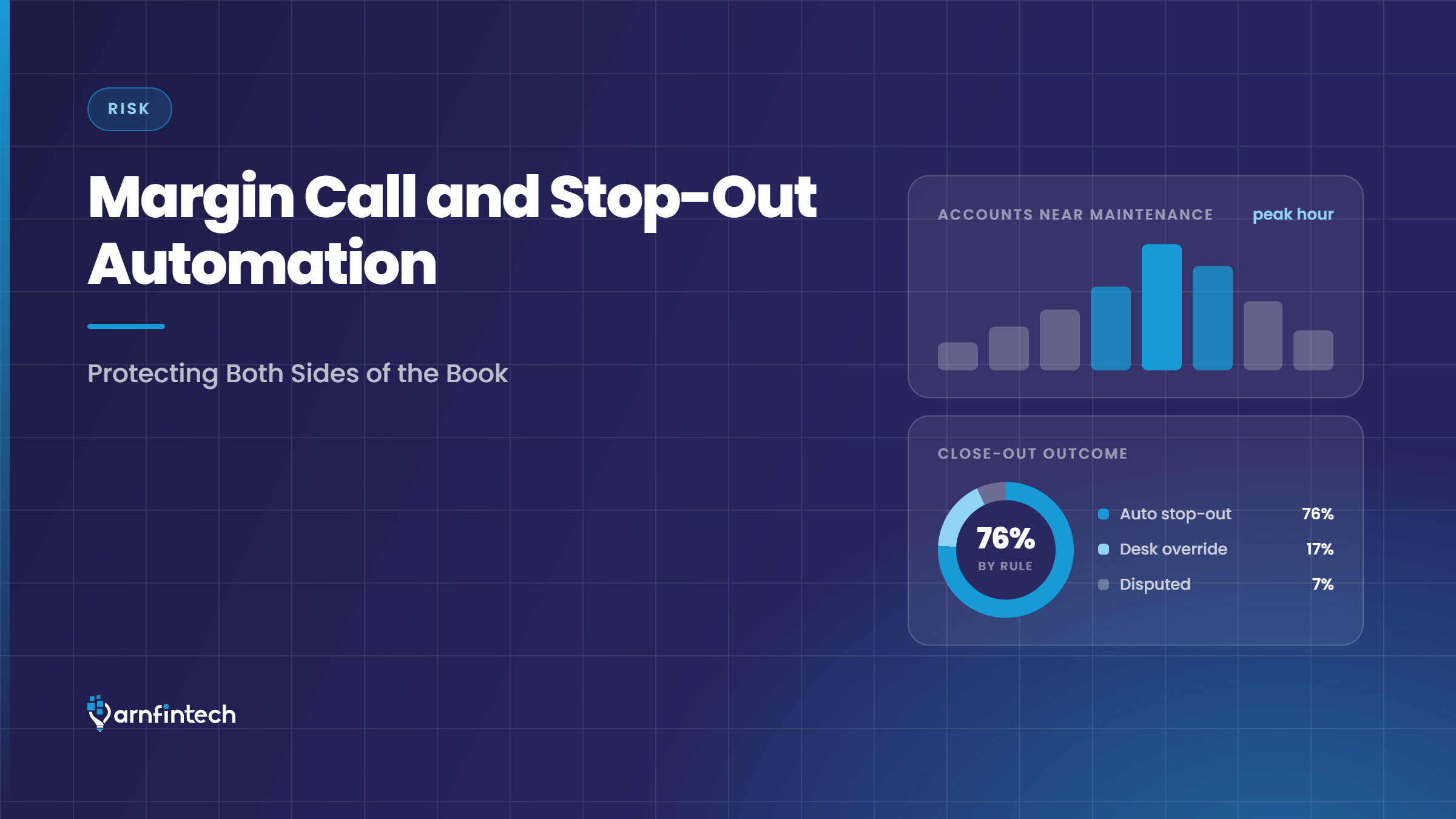
The firms that handle audits calmly are not the ones with the largest compliance teams. They are the ones where the audit trail is generated automatically by the systems doing the work. Verification writes its own result. A leverage change writes who changed it. A margin call writes the level that triggered it and the notification it sent. Nothing is compiled after the fact, because nothing needs to be.
This also changes the internal conversation. When the trail is always current, compliance stops being a gate that slows operations down and becomes a read-only view of what operations already did. Reports for the regulator and reports for the board come from the same source, which means they agree.
Architecture decides how fast you can answer
Assembling a client narrative across a fragmented stack means exports, timestamp alignment and manual matching. Doing it inside a monolithic platform means running heavy historical queries against the same database your dealing desk depends on — so the audit response competes with live risk management.
The workable arrangement is the one that applies everywhere else in a brokerage: independent modules that share one client identity and one clock. The CRM holds identity, documents and communications; the RMS holds exposure and risk decisions; the IB layer holds attribution. Each writes its own trail, and because they agree on who the client is and when things happened, the full narrative is a query rather than an assembly.
ARN Fintech's CRM, RMS and IB modules each maintain their own timestamped record over a shared identity layer, so a regulator's question is answered from the systems rather than reconstructed for them. Talk to us about what your current stack could produce, and how long it would take.